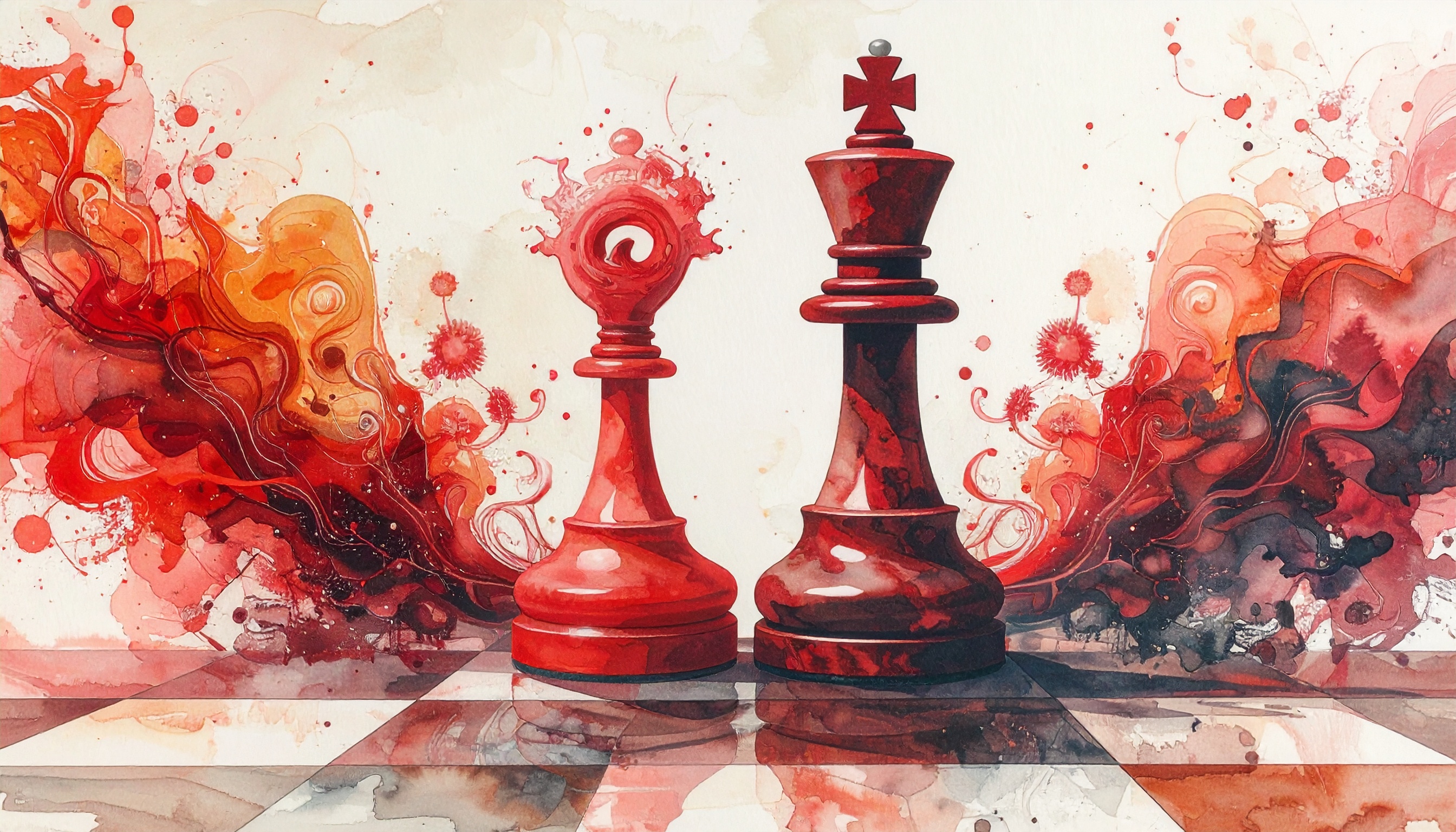
The Red Queen Runs, The Red King Waits
Alternate title : Evolutionary Lessons for AI and Humanity
This morning has been a meandering through the world of chess on Duolingo, alternating between lessons and open play against the game’s tutor, as I make small yet satisfying strides in my ELO rating climb. The addiction is real: the queen commands vast territories, wreaking havoc with blistering speed, her presence a burst of tactical chaos that forces the board to bend in response. The king, meanwhile, moves with a measured grace - slow and deliberate, each step a quiet pursuit of positional balance. Of the twenty-plus games I have played this morning, the king has moved only when needed to, while my pawns promote to queens and unleash more chaos agents across the board. At the end of the day, the queen(s) make moves to ensure the king(dom) does not fall.
Moves and Counter-moves
This brings to mind the adaptation of Yellowstone National Park’s food chain following the reintroduction of wolves. Much like chess, the absence of wolves created imbalance: increased elk populations led to overgrazing, devastated vegetation, and unstable riverbanks, further impacting beavers. With their return - like pawns promoting to queens - the ecosystem underwent local chaos towards long-term good: elk avoided river valleys, allowing vegetation and riverbanks to recover and the beaver population to rise.
Nick Bostrom’s Super Intelligence reads differently now, looking somewhat at the past, not all of it hyperbolic and obtuse science fiction, with the progress in the field of AI and genomics. I have indeed made inroads with the book this time around than a decade ago when I last tried to read it. So far, evolution reads as a series of dynamic equilibria at its core; every adaptation provoking a counter-adaptation, every move reshaping the environment. The type of moves directly characterizes each evolutionary step as one of the queen or the king. This tense oscillation, I think, holds the key to how we as humanity will co-evolve with AI, towards a superintelligent future.
The Red Queen Hypothesis: Run to Stay Still
“Now, here, you see, it takes all the running you can do, to stay in the same place.” - Lewis Caroll, Through the Looking Glass.
The Red Queen’s Race postulates that all species must constantly adapt and evolve to survive the attack from other species. Humans fought off predators like lions and tigers by learning first to create vigilant attack formations, and then by creating impenetrable shelters. Likewise, rabbits evolved to have speed to avoid predators like foxes as a defensive adaptation, while the foxes also evolved to have speed for a similar adversarial advantage.
The Red King Hypothesis: Slow and Steady Wins the Alliance
The Red Queen’s race is simply put - adapt or perish, even if to simply maintain the stability. The stability itself hinges upon both sides continuously adapting; if either side stopped, they would perish. The Red King hypothesis, on the other hand, suggests a slow, but progressive evolution through mutual co-operation. Can the fox and the rabbits agree on a symbiotic relationship similar to coral-algae symbiosis? Perhaps a measured attack on rabbits allows rabbit populations to grow while maintaining requirements for sustenance, creating a harmonious balance in the ecosystem. These systems, as evolution indicates, go through periods of both competition and cooperation, endlessly, dancing through time.
Humanity’s Turn: Evolution Within Our Own Species
I wonder at these hypotheses’ relevance for intra-species evolution through the lens of Darwinian evolutionary theory of ‘survival of the fittest’. Loosely put, let’s consider all evolution to have some form of fitness function that we can measure for the capabilities we consider to be above general intelligence, spanning the ability to learn, recursive self-improvement, deal with uncertainty, and create flexible internal representations.
Sperm selection by definition is an intra-species arms race - the fastest sperm wins. Enhanced by advanced methods like magnetic-activated cell sorting (MACS) and genetic trait selection, the fastest sperm is now also the most genetically preferred. As new generations of these “advanced” humans come up, we now look at further genetic selection, aided by more technological advancements. In essence, ever since the beginning of time, we as humans have co-evolved competitively as the same species for the best version of ourselves to be put forth.
Now, imagine flipping the Prisoner’s Dilemma: cooperation, not betrayal, yields the higher long-term payoff. In this iterated version, suppose one prisoner adapts slowly – rarely updating their cooperative strategy – while the other reacts rapidly to each round. Over repeated interactions, the fast learner would continually adjust to sustain cooperation, effectively conceding more, while the slow learner anchors a favorable equilibrium. This mirrors the Red King effect. The slower player effectively anchors the cooperative equilibrium and captures more of the long-term benefit.
However, the analogy holds only when adaptation rates differ within a feedback loop (i.e., one step). When both agents evolve at a similar speed – or the environment itself stands still – the asymmetry collapses, reverting to the familiar Prisoner’s Dilemma. Cooperation erodes; betrayal once again becomes the rational choice. The system slips into a Red Queen’s Race, where both must run faster simply to survive. The slower player is forced to abandon their anchored advantage, i.e., adapt, or go extinct. Betrayal gives way to chaos.
Intriguingly, all the “rational agents” here – the prisoners and the jailers – belong to the same species. But what happens if one of them isn’t? What if the faster runner in this co-evolutionary race is a superintelligent AI? What if we remove the notion of rationality to introduce chaos monkeys?
With some full-blown meandering, when I zoom out to the global scale, the world itself seems caught in a Red Queen’s race. Nations sprint to preserve their GDP; companies accelerate to defend their market share. The answer to the survival puzzle simply seems to be motion. In quieter moments, I notice the same pattern in myself - keeping myself abreast of breakthroughs in LLMs, frameworks, and agentic AI, just to stay relevant. Running, learning, updating, never quite arriving. And, I wonder, in this endless chase for adaptation, am I too a Red Queen – running only to remain in place?
The Superintelligence Dance
Given that all systems must evolve through some form of feedback, either through a direct measurement of the fitness function or through indirect signals from the environment, perhaps the path to superintelligence is also defined by the tempo of Red Queens and Red Kings.
AI-2027 ends with a choose-your-own-ending: a deliberate slowdown toward measured, stable progress or a full-blown race toward superintelligence. I find myself somewhere in between, believing we need both Red Queens and Red Kings; the Red Queens to evolve our defenses, developing prompt shielding, red-teaming, and new countermeasures against adversarial ingenuity. And the Red Kings to steady the pace, building interpretability, AI governance, and ethical alignment into the foundation itself. I wonder though, in the iterated Prisoner’s Dilemma of human-AI coevolution, can we choose to be the slow adapters, the species that anchors cooperation? To hold our ground long enough to define the “equilibrium” we desire? The pace of AI will continue to accelerate, reshaping the environment in which we operate. Yet if we hold firm on the core of AI safety, we – the effectively slower species – still have a rare opportunity: to define the cooperative equilibrium, even as we necessitate adaptation around it. Slowness, in this framing, is not inertia but intentionality: a deliberate safeguard in the face of runaway adaptation. The runaway state is bound to happen, by the consideration of AI evolution to be akin to biological evolution.
The Emergent Red Duality
Ultimately, the queens are nothing if the king falls. In the grand game of evolution, if we cannot learn to build safer systems amid this oscillating pendulum of moves and counter-moves, we risk checkmating ourselves out of off the board entirely. The true endgame is not humans versus AI, but humans + aligned AIs. We will reach that equilibrium only through alternating phases of rivalry and adaptation, through Red Queen races that push our defenses forward, and Red King moments that create leverage for our long-term sustenance as a human species.